
Today we’re looking at Jasonite’s ‘Structural Criteria’ for Horror RPGs: well-written, thoroughly thought out, and (in my opinion) totally wrong.
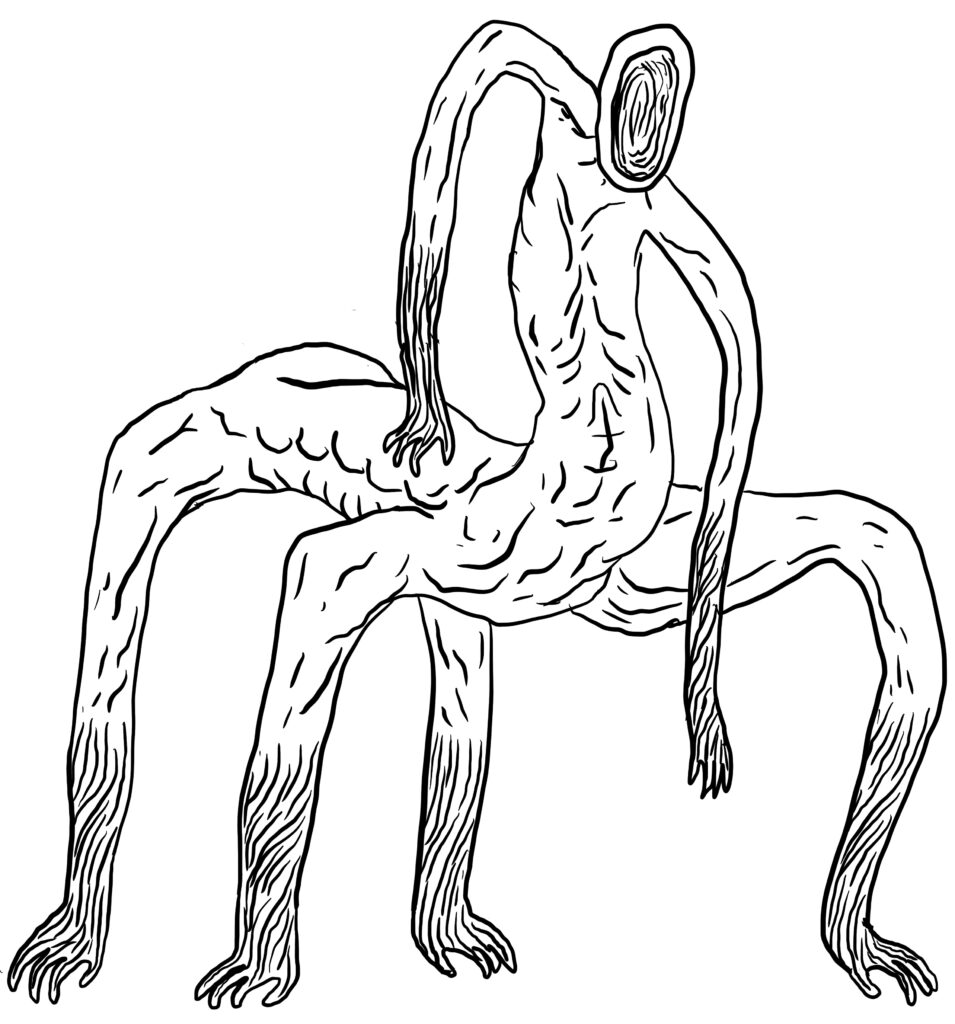
Friends, I have been on Reddit.

I don’t know. I have problems. I’m sick in the head. I’m a glutton for punishment. Forgive me.
In any case, amidst the psy-ops, guerrilla marketing, and undigested mental regurgitations, I found this post by a fellow going by u/jasonite. The post leads this longer discussion on his blog.
Now, there’s some low-hanging critical fruit here: the AI-edited writing style, the no-true-Scotsman/one-true-way argumentative style, the fact that this guy clearly hasn’t actually played any damn Mothership. You can see variations on those critiques in the Reddit thread comment. There’s also, I think, some internet points to be harvested via outrage over the last-minute pitch for a paid ‘Structural Audit’ of your RPG system. The price is a mere $500 for a single question to $2800-$6500 for a ‘full audit’.
One presumes these prices are in USD; a Canadian would have preemptively apologized for their audacity.
Yet despite these factors, I do want to shine a spotlight on these ideas. Mostly because they’re bunk. I recall a similar line of argumentation floating around the blogosphere some ten years ago: the idea that the difference between Fantasy and Horror is the difference between growing in power or dwindling in ability. And although I think there’s a modicum of truth to that, I don’t think it’s a rock worth building your house on.
Let’s get into it.
Warning: We’re going to be talking about movies. Spoilers of varying intensity for Pearl, X, Alien, Terminator, Scream, Cabin in the Woods, and Hellraiser.
Jasonite’s Horror RPG Rules
- Engagement is Toxic – Every action costs your character something, even when you succeed.
- The Floor Permanently Drops – Maximum stability or safety steadily erodes; temporary relief doesn’t undo the ratchet.
- The Rules Take the Wheel – Control gradually shifts away from the player, making survival or success partially outside your hands.
Engagement
Rule number one accurately describes the problem with every bad Mothership module I’ve ever played. When engagement is punished, the natural reaction is to stop engaging. When you stop engaging, the natural consequence is that you see less of the adventure. Seeing less of the adventure means (if it’s a fun adventure) that you’re missing fun.
Boo!
Engagement with a Horror TTRPG should not be ‘toxic’. That’s for engagement with Reddit.
It’s okay for the puzzle box to be cursed. It’s okay for the house I’m inheriting to be haunted. But once the blood’s in the water, you can stop punishing me for playing, please and thank you. It doesn’t ‘cost’ Ripley to don the spacesuit and depressurize the ship in Alien. The ‘price of transgression’ was paid when they picked up the egg. After that point, the crew’s options are a mix. Some choices lead characters to death; others, to survival.
If there are no good choices, that’s not much different than no choices. If there are no choices, I’m not playing a Horror RPG; I’m passively receiving a story.
The Floor Drops, Permanently
This is the closest to the 2010’s Horror v Fantasy argument. Basically, damage is crippling.
For me, this is good design for a horror TTRPG one-shot. If I get shot, I want to feel it. If I see the monster, I go a little crazy. Sure. That all works. But I think it falls apart in campaign play. Before I get into that, I want to feature my favourite comment from the Reddit thread, an argument from the well-spoken and clearly intellectual u/figshitter.
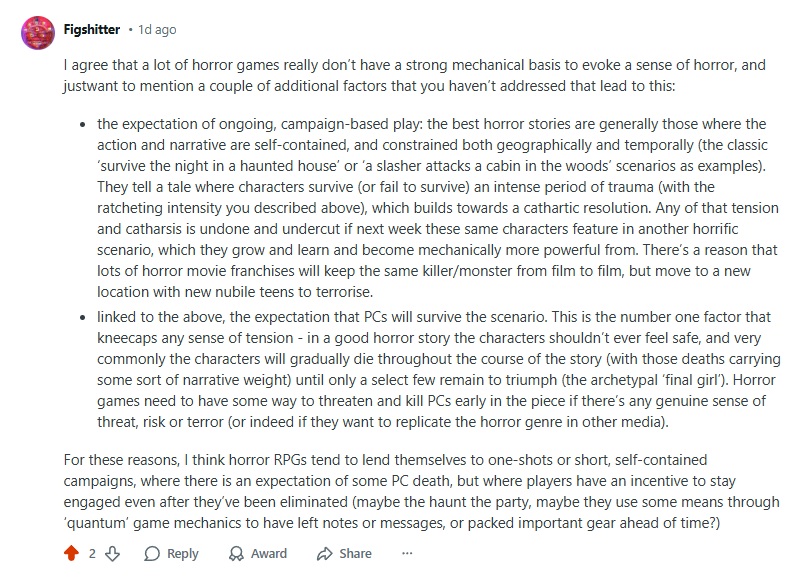
So, Figshitter’s point is well-taken. Picaresque, forever-campaigns are ill-suited to horror because they’re predicated on a returning cast of characters, whom we presume will survive most of their outings. However, I think it’s worth highlighting that multiple horror franchises do see their heroes grow over time.
In film, Ripley is a classic example. In Alien, she’s a bad-ass space trucker; in Aliens, she’s the foremost expert in killing Xenomorphs. Sarah Conner also jumps to mind. In Terminator, she spends a fair amount of time damsel-ing; in T2, she’s a warrior. Neve Campbell’s character in Scream is another example; she grows in skill with each killer she defeats.
So, although this ‘racheting’ effect is an essential part of a horror adventure, I think it’s ill-suited to a campaign. You should at least begin each individual mission feeling confident; it makes it much more satisfying when the bottom drops out on you later.
Mind you, I think Mothership in particular does a pretty good job of this. The high cost of healing conditions and wounds means you often find yourself drawn into deeper engagement with things you know are dangerous, just because you need money to get back to zero. In other words, the ‘ratchet’ drives engagement, rather than discouraging it, and characters do have a chance to grow stronger over time.
Presuming they’re smart/lucky enough to survive, naturally.
Losing Control
Okay, so Jasonite’s minireview of Ten Candles makes it sound dope, and I’d love to play it. Perhaps once I do, I’ll feel differently. But for right now, today, I think this is probably the single worst piece of gaming advice I’ve ever seen. It’s the main reason I wrote this blog post.
As I’ve said a million times, AGENCY IS THE FUN.
We sit at these tables for two reasons:
- Roll the Dice
- Make the Choices
A GM who takes away your agency is cheating both of you out of a better game. Doesn’t matter what the genre is. Player choice must be front and centre.
In horror, this is perhaps even more important. Think of Cabin in the Woods, metatext par excellence:
They have to make the choice of their own free will.
In Cabin, agency is front and centre and, perhaps more importantly, it grows over time. When the ‘adventure’ starts, the cast have been subtly drugged. They run around a rat maze made by the Organization. It’s only at the halfway point that they truly seize the initiative. And at the conclusion, they must make the ultimate choice: the world or their humanity.
If you’ve seen the movie, you know what I mean. If not, go watch it now; it’s seminal.
No meaningful story can exist in the absence of player choice. Losing control is horrifying. It also makes the story meaningless. Babadook, Midsommar, Nosferatu: all these films end on characters who make massive choices. These are costly victories, resulting from choices by characters who have spent the film having their agency challenged.
The primacy of choice is why the ending of Pearl lives rent-free in my head, while the ending of X is both predictable and forgettable. Pearl’s choice to ‘trust love’, despite how monstrous she is, is era-defining; Maxine’s choice to… shoot the villain and drive away? Less memorable.
Player choice becomes more important as the game goes on, not less. That’s the same in horror as it is in any genre. Even if things spin fatalistically towards a tragic end, that final moment needs some choice. If there is no chance to escape and survive, then a fork between taking the monster with you or uncovering the truth works well. Mothership, again, is excellent at this. The goal-trio of survive, understand, or save is great; just remember, you can’t have more than two!
Final Word, Final Girl
Horror is rough on the characters, but it should still be enjoyable for the players. We are, after all, playing a game here, right? Just like a horror movie must entertain, so too must a game be fun. So don’t let engagement with the fiction turn toxic. Give players a chance to grow between sessions.
And for the 1,000,001st time, give the players as much agency as possible!
Apologies to Jasonite for the harsh critique. If you ever want to shittalk anything I’ve written, let me know, and I’ll make sure you get a free copy to rag on. For the rest of you maniacs, keep reading this blog! Check out Gabriel’s Honest Mothership Review, this alternate Mothership Panic Table, one of our many Blood Prairie Playtest Reports, or this fine toolkit for generation ship horror. Stay Weird!