
Tuesday Knight Games has released Fatherfog, a Fairytale Horror game based on Mothership’s Panic Engine! How does it compare? Read on for an honest review!
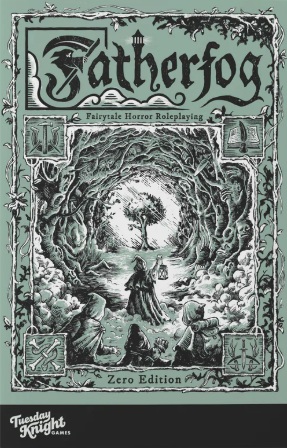
My experience has all been on the GM’s side of the table, having run both Into the Fog (the official intro adventure) and Three Sisters of the Glass Mountain (our 1st place entry into the TripTales Jam). I spoke, at length, to all my players after each game, so I think I’ve got a pretty good handle on the player experience as well. If you prefer watching to reading, consider a click HERE; the inimitable Mystery Quest is doing an Actual Play of our pamphlet adventure, so you can see the game in action for yourself. If you prefer something more analytical, read on!
The Basics
Fatherfog takes place in a post-apocalyptic world where fairytales are real, malicious fog blankets the earth, and hope is the most precious thing you have. It cleverly sidesteps meta concerns by telling the players that their characters know everything about fairytales that they do, but that these stories are only ever half-right.
If you know Mothership, you’ll find the rules here have only grown more elegant. Fatherfog eschews the d20 panic table/stress system in favour of a d100 hope/despair system. This means you’re only ever rolling d10s (which is nice), but it also allows for more granularity when you freak out and everything goes wrong.
It also introduces the ‘Bit System’. In Mothership, when you fail a check, you gain 1 Stress. In Fatherfog, failure often costs a ‘bit’ of Health or Hope. You look at the ones place on your failing roll, losing that many. This also lets you swap between campaign play (where losing 1 hope is quite common) and one-shot play (where losing a Bit accelerates you into the horror).
Players also get Legacy Artifacts, fairytale-inspired magic items that give them a special ability. They’re often quite niche, so they don’t feel overpowered, but they do give a little something special to every character. Our game of Into the Fog ended with one of the PCs eating a bunch of magical mushrooms (not that type), becoming a giant, and then stomping an old lady-witch who lived in a giant wooden shoe. Everyone else died. In my book, a perfect one-shot ending!
So far, this Fatherfog review is pretty positive!
Fatherfog Classes
As I said, this Fatherfog review is somewhat GM-facing. But few things are as important as the player options. Although I only have my observations, Fatherfog seems to deliver very strongly in this aspect.
Our lineup consists of Hunter, Philosopher, Worker, and Stranger. They’re well-designed. They give you a clear direction to take a character without locking you into anything too hard. The clear MVP is the Stranger class. It takes everything I love about Mothership’s Android (being equal parts useful and frightening) and cranks it up to 11. Check out Lydia’s Stranger in the Mystery Quest playthrough; you’ll very quickly see the appeal.
Art
No Fatherfog review would be complete without discussing the visuals. There’s almost a lithographic quality to a lot of the art, which fits the fairytale setting to a T. The core Fatherfog book is done in greens; Into the Fog is done in oranges. For ‘Three Sisters’, we followed the orange cues of the intro adventure.
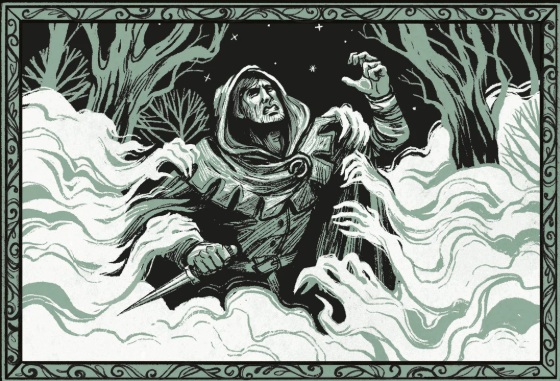
I really love the look. It’s mysterious, simple, and dreamy. It feels period-appropriate. Keeping these simple colour palettes really gives it a ‘woodblock print’ look that I admire.
Death and Monsters
Online criticism of Mothership tends to centre on its combat system. Fatherfog addresses almost all of those concerns. GMs announce monster actions, players respond, dice are rolled, and then both actions resolve. Monster stat blocks come with tactics that evolve based on the creature’s current Health. It’s a cool idea! Yet, they’re still simple enough that they don’t occupy more than a quarter panel of an A5 page. Very nice.
Online praise for Mothership often celebrates the hidden death die mechanic for fallen PCs. As Gabriel has said to me on a few occasions, the drama of slamming a cup over a hidden die adds a lot of juicy drama to the proceedings. Fatherfog’s system is a little different: you get a Body Save to avoid Death and, if you succeed, the Grim Reaper offers you a price to stay alive. It’s a super fun little table, a great social encounter, and a very on-tone way to handle death. PCs who do die get to pass a little extra juice along to the next character (plus their legacy artifact). It helps take the sting out of this highly lethal game.
Support
Nothing beats ‘ease’ when it comes to RPGs.
Ok, so this part isn’t really a Fatherfog review. It’s a review of the tools the community has produced for it.
It’s fascinating to me how easy it is to sit at a table (with a good GM) and dive into a game without knowing the rules, yet how hard it can be to make a worthy character if you don’t know the game. Although TKG hasn’t yet released anything comparable to the excellent Mothership Companion, there is a fan-made character generator that makes it very easy to jump into playing without having to explain a bunch of stuff up front.
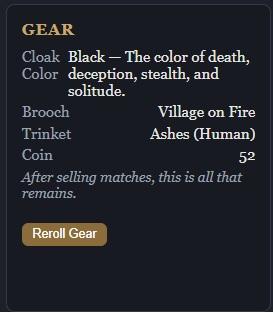
As a side note, the character creation stuff is so juicy. Fatherfog characters express themselves through cloak colours and clasps, and your starting cash comes with a history to explain it. Here’s the Gear of the first lil guy I rolled up. Not only did this character come to me practically fully realized, but he was also exactly the type of menace I love to play.
The Downsides
Ok, honestly, I’m not even sure if I’d call this a downside. It’s just the only negative thing I can think to say. I’m trying to maintain a semblance of balance!
I suspect Fairytale Horror might be too constrained to generate the quality of third-party content that Mothership has.
Now, admittedly, this is a possible future concern, not something that will affect your table. But I do think it’ll ultimately play on the longevity of the system. Because you’re adapting a finite body of preexisting work, I imagine that a lot of the low-hanging fruit will pretty quickly be taken. There’s a relatively narrow tranche of ‘on-theme’ stories, compared to Mothership, which works as well for Sci-Fi Bounty Hunts as Ghosts on a Starship.
With TKG’s license agreement allowing them to act as the ultimate Gatekeepers on what gets released, I find myself wondering: how many Big Bad Wolf adventures will they allow? How many Gingerbread Man or Jack and the Beanstalk adventures? Although there’s an incredible depth of folklore to draw on, the number of stories that are familiar enough to really resonate when you start twisting them is probably no more than two-dozen or so.
Third-party creators will probably find new and exciting places to take this system: non-European folklore, totally original stories, non-horror takes, etc. But until those paths are explored, I worry that this might be a smaller, more niche game than Mothership. Which kind of sucks, because in a lot of ways, it’s even better than its old sibling.
Our Honest Fatherfog Review
I consider Fatherfog a strong step forward from Mothership, which is itself already one of my favourite games. I expect a lot of the innovations on display here will make their way into Mothership 2e and other, future Panic Engine games. It’s competing on a crowded field (fantasy TTRPGs), but it has a defiantly unique character to it that sets it apart. Over the long run, we’ll see how deep the lane it’s chosen can go.
The games I ran sat three players each. Two of them (the ladies at the table) each said to me separately afterwards that Fatherfog is their new favourite TTRPG. Reviews don’t get much more honest than that!
Thanks for reading our Fatherfog review! Keep reading with Gabriel’s Honest Reviews of Mothership and Mork Borg or catch up with us in our recent Recap. Alternatively, skip the reading and go play Three Sisters of the Glass Mountain! It came first in its Jam, so I’m going to call it THE BEST FATHERFOG ADVENTURE TO DATE! Is that Hyperbole? Publish your own honest review (in the comments or elsewhere) and tell us why!