OSR games are deadly… but, what does this even mean? I did a flip through review of the Cairn 2e Player’s Guide and stated that Cairn is very deadly, and I don’t know that I want something that deadly as my daily carry RPG. I was fortunate enough to get the attention of, and a response from the system’s creator, Yochai Gal:
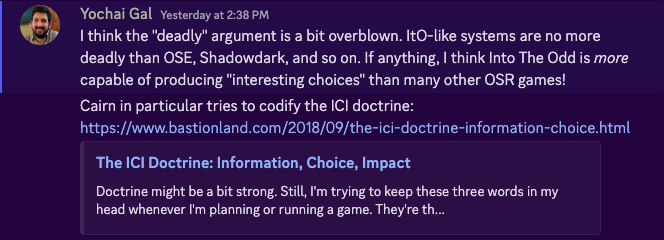
And you know what? He’s right… and also a little wrong. Capital “R” right, and minuscule ‘r’ wrong. But to understand what I mean by deadly, and what he means by overblown I think we need to analyze what deadliness in an RPG means and how we can compare systems on this plane of potential.
To do a thorough analysis here I am going to compare 3 different systems in the OSR that I think are fairly representative of the category I am hereby coining the lewis trio and one additional system that I think changes some of the conversation about deadliness, Troika! So, let’s define some terms.
Damage Pools
Any points depleted by damage. Commonly, Hit Points.
Shadowdark
Fairly standard, you have hit points based on your class and level. Get hit, deplete them. Run out, you are dying. The hit points you receive only benefit from your constitution modifier at first level meaning this system has slightly more flat HP values throughout the life and progression of a character.
Old School Essentials
Based on BX D&D, this system is by far the most standard in historical RPG terms. Again, hit dice for class, rolled every level, constitution modifier applied each time. This means you will get slightly wider variance through progression, but only occasionally. You take damage when you are hit, and when a character’s HP is depleted that character is dead, no timers or saves.
Cairn
Based on Into the Odd by Bastionland Press, this game has a unique take on damage and deadliness in that it is split between two damage pools. The first is the Hit Protection pool, this starts with a d6 and can improve only when a character is “scarred”, when they reach exactly zero hit protection. Hit protection can be easily replenished by taking a breather and some water.
Damage done over a characters hit protection is then deducted from the character’s Strength score, and in fact all Attributes (Strength, Dexterity, and Wisdom) are tracked with a current and max value. When an attack damages Strength, the character must make a Strength save (roll under current Strength on a d20) or take Critical Damage.
Critical damage means the character cannot act and can only crawl, effectively removed from combat. It also sometimes will have special effects defined on the attacker. If a character is reduced to zero Strength, they are dead.
Troika!
Troika uses a Stamina pool, similar to a standard hit point pool, but the stamina your character starts with remains the same throughout all sessions, unless modified by some diegetic magical or technological means. Initial value is 2d6 + 12, or 14 – 24. Damage is applied to a character’s Stamina and when it is depleted the character is dead. Notably, characters casting spells also take Stamina damage to do so, regardless of the spell casting result.
Damage Frequency
How often a PC is exposed to damage is what I am going to refer to as damage frequency. By exposed I mean actively removing values from a pool. Let’s dig into the different systems and how they each handle Damage Frequency.
Shadowdark
A character takes damage when an enemy attacks the character and rolls over the character’s Armor Class. This number is usually between 11 and 17 and enemies usually roll 1d20 +1 – +6 when attacking. This is going to result in a 25% – 50% hit rate, depending on Armor class and enemy difficulty. Some enemies may attack multiple times on their turn, though PCs can not.
Old School Essentials
Similar in some respects to Shadowdark, though there is a nuanced historical component in Thac0, or “to hit armor class zero”. This originally showed up in early versions of D&D to allow “Armor Class” to be treated in the same sense as airline seating, or military rank. This means 1st class is the best class, and the lower the class the worse the value. The objective was still to roll high on a d20 and the idea of ascending armor class has largely won out, being an alternate system in OSE, and a main system in most other BX clones. When a roll is high enough to hit the PC armor class, the enemy does damage, same as shadowdark for the most part.
In OSE Advanced the opportunity to attack multiple times was added to player characters.
Cairn
The innovation of Into the Odd and hence Cairn is the removal of the “to hit” roll. All characters attacking a target roll all damage dice available to them, then the highest among those is taken and applied as damage. The damage is then reduced by Armor before being applied to hit protection and ultimately strength. This means all attacks against unarmored PCs do damage.
Troika!
Another shake up to the formula is the Troika combat system, in which a melee combatant rolls a contested combat roll against their target, the winner then deals damage to the loser, modified by armor. This means that every time you make a melee attack you are risking taking damage, and every time you are attacked you have the opportunity to deal damage. Missile attacks work slightly differently in that a defender rolls dodge to contest and simply avoids taking damage on a success.
Damage Amplitude
This refers to the amount of damage removed from a pool on any given attack.
Shadowdark
This is a fairly standard system where damage is rolled and applied, usually without modification. Some abilities and spells allow for multiple high-value dice to be rolled but the common attacks found in melee and missile weapons will range from 1d4 – 1d12.
Old School Essentials
Similar in most ways to Shadowdark, the weapon or attack damage rolled is applied directly to the hit point pool. There is a slight variance here in that the Strength modifier for a character is also added to melee weapon damage.
Cairn
This is the standout system here in that the damage that can be applied to a character on a given round of combat is bounded the extremes of a single die. So, at most an unarmored character could expect to take 12 damage from an enhanced attack.
Troika!
Another unique system in that each weapon and monster applies damage from a table. A d6 is rolled and then checked on the table to resolve the damage dealt. This means that while the damage can be anything on the table, it is also paired down to only 7 potential values for any given attack. The weapons and enemies in the core rules provides damage ranging from 1 – 24.
Armour
Shadowdark
Wearing armour improves a characters armour class, reducing the change they are hit by an attack at all. This modifies damage frequency, not amplitude.
Old School Essentials
Same as Shadowdark, modifies amplitude only.
Cairn
Armour is ablative in this system but is also hard capped at 3. This means that while this technically only changes damage amplitude (since damage frequency is 100%), because of the way damage is only applied from a single die roll, the frequency is also changed when the damage rolled is lower than the armour value. So a character with 3 armour would take no damage from attacks rolling a 3, 2, or 1 on the die. That character would also take a maximum of 9 damage from an enhanced attack.
Troika!
The strangest implementation yet, troika has armour ratings of unarmoured (-0), lightly armoured (-1), modestly armoured (-2), and heavily armoured (-3). But the armour rating modifies the die roll, not the damage value. So a heavily armoured character hit by a Gigantic Beast would be able to take at most 12 damage, but would never take less than 4. Not truly ablative, this means Troikan armour only modifies damage amplitude.
Death Rules
This section will talk about how each systems deals with an empty damage pool. What happens when you reach zero in a given pool, and at one point to become unable to respond to threats.
Shadowdark
When you reach zero hit points, you are unable to act. You roll 1d4 and add your constitution modifier. In that many rounds, without aid, your character dies.
Old School Essentials
When you reach zero hit points, you die immediately.
Cairn
When you run out of hit protection, you need to make strength saves. If you fail you become unable to act. You will die without aid. If you reach zero strength, you die immediately.
Troika!
When you reach zero stamina, you die immediately.
Resilience Progression
This section rates how each system changes character resilience to damage as they play. How does the character improve over time and what impact does that have on deadliness.
Shadowdark
Linear progression from levels 0 – 10, each level improves the damage pool by a fairly stable amount, though monsters at higher level also tend to do more damage.
Old School Essentials
Linear progression from level 1 – 14 (36), each level improves the damage by a fairly stable amount, monsters at higher level tend to do more damage.
Cairn
Progression only on random event (scar) and a chance on that event to improve your damage pool. While it is possible to improve any stat or hit protection from this, its also possible to die from these events. This means that in practice, your HP will stabilize to a maximum value of 18. Your strength will remain between 3 – 18.
Troika
Troika does not change stamina values through play and there is no progression that improves survivability outside the skill improvement, which can reduce damage frequency.
What Have We Learned Here
So, as with all things TTRPG, the devil is in the details and the details are specific to your table. The things that make an OSR game deadly can also add texture. In my case, I often run Cairn with only one or two players, this means that the critical damage save is much more likely to result in a PC death than it otherwise would. In Cairn, there is some safety in numbers. Also, because the damage and HP level remain mostly flat throughout campaign play, the game remains deadly through the whole campaign. This is actually ideal in most cases, and if I had a larger group of Cairn players it would likely make this better for me than some other games.
To Yochai’s point, I do think Cairn offers more opportunities for interesting decision making than the more traditional D&D like, and even more than my sweetheart system Troika!. I will never turn down an opportunity to run Cairn and will include it in my repertoire when offering up games for as long as I am rolling dice.
Did you like this breakdown on damage and deadliness? Want to tell me I’m wrong, the OSR isn’t deadly, isn’t deadly enough, or complain that I didn’t cover your favourite system? Shoot me a comment or an email, I’m happy to hear your take! If you like deep dives you might enjoy Austin’s analysis of Troika skills or his brutal take down of the Armour System. If you want to get more fresh articles from Austin, well we need to come up with some money to pay him. Maybe check out the Patreon or buy an adventure book.