
Today we review Nirvana on Fire, one of my favourite Mothership modules!
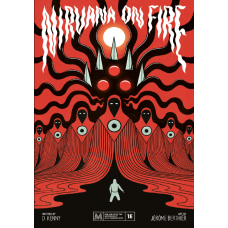
You may recall we did a Micro-Review of Nirvana on Fire some time ago; well, I’ve run it several times since then, and I think we’re overdue for a deep dive. So, without further ado, let’s get into it!
The Basics of Nirvana on Fire
Nirvana on Fire is a Magnum Galaxy Games production, with Dave Kenney on keys (with contributing writers Noora Masyk and Roz Leahy) and Jérôme Berthier on lines and inks. Also credited are James Mendez-Hodes, Eric Hill, Meredith Silver, and Arnold K. of Goblin Punch. The plot involves a failing colony of Neo-Buddhists, biomechanical mutation, and a conspiracy to make an AI into a god. It runs 36 pages and includes two sub-adventures, a new character class (Acolyte), and a fully usable back cover.
We’ll get into the specifics of the writing in a paragraph or two, but first, let’s state the obvious: Berthier’s art is incredible. It balances a simple, bold colour palette with a wonderfully psychedelic complexity. There’s a ton of illustration; I found only a few bare spreads in the entire book. The deluxe version even includes some large-sized poster art. If you run this module, I highly recommend finding ways to show some of this art to your players mid-game.
Opening
I typically run this module with the crew defrosting on the edge of the star system, about a week away from Siddhartha’s Peace. This is for a few reasons.
- It lets me run down the seven-day clock on cryosickness. Sidenote: there’s no better way to begin a Mothership adventure than by describing coming out of cryosleep. I go for something between Austin Powers and Neo waking up from his pod in The Matrix. If it’s not horrible, you’re not doing it right!
- It gives the PCs some time to receive the mission brief and do a little research/anticipating.
- There’s time for the PCs to establish a little character and some relationships before they get thrown into the action. This is particularly important with one-shots and Convention games, which tend to be how I run this module.
- Finally, and most importantly, it gives me seven chances to use the Prophecies on Bishamonten on the back cover.
I use the two transmissions from the Open Contract hook (p. 6). It’s a fantastic way to open the module. The players get a quick peek at the local faction conflict, some exposure to the big bad, and some freaky cult nonsense. Throw in some Sanity Saves, and you’re very quickly getting the crew into a Mothership headspace.
One thing this module nails that others often leave underserved is the theology of its villains. There’s just enough real-world touchstone here to let a canny GM really dig into the weirdness, while still being distinct and ‘space-age’-y enough to avoid getting lost or bogged down in similar real-world stuff. The prophecies are great; mixed with a little AI-hacking attempt from BIshamonten, they can really help introduce the danger and tension right up front.
The Abbot and the Colony
Once you get the crew to the planet, they’ll usually end up walking around the colony of Siddhartha’s Peace.
The adventure does contain an alternative; your players could ignore the Abbot’s warnings and check out the surface’s other power signature. This will lead them into a black dome, intermittently hidden by the sea and populated with messianic clone-mutants. This part of the adventure looks incredible; having run this module about five times, I’ve never had a party get past the exterior of the building before changing their minds and going to talk to the Abbot.
Players, man. I tell ya.
Still, it looks like a great little adventure. Someday I’ll get a party to bite on it, and when I do, you folks’ll be among the first to hear about it.
The Main Story
The adventure’s main line takes the PCs to the colony, where they get to walk around for a bit, taking in the sights. What are those sights? Well, mostly rolling blackouts, suspicious cultists, bio-mechanical rat mutants, and (in some cases) a violent revolution. Past the random encounters and breakdowns, we reach our first two big NPCs: Fugen and the Abbot.
Fugen’s fantastic. I’m a big believer in giving the PCs a slightly pathetic pal to latch onto and fight for. Fugen fits the bill perfectly. He’s like a bad publicist; he tries to sell the colony’s strengths, but can’t help pointing out its weaknesses. A minor character, but really fun to play.
The Abbot is the real gem here. I love how Mothership doesn’t mess around with Sense Motive rolls or anything of the like. When NPCs lie to the crew, the GM can just tell the PCs they’re being lied to (see Warden’s Operations Manual 36.1). When that’s combined with a well-meaning (but highly deceitful) NPC like the Abbot, you get some really great roleplay. Without fail, I see my players’ faces light up when I end his little quest-giver speech with “… he says, sweating anxiously as he lies to you.”
The Terraforming Tower
Nirvana on Fire’s climax takes place in the Terraforming Tower atop the colony’s space elevator. There’s a lot to love here, so I’ll go through the rooms, but before I do, I want to talk about the big picture.
This is a classic Mothership ‘dungeon’. We’ve got multiple entrances, varying scales of rooms, a great flowchart map, different levels of keycode locks, and a persistent chance to interact with the villainous AI. The random encounters are great, showcasing the presence of danger constantly while still giving the PCs a chance to prepare for those encounters. Honestly, it’s shocking that there are really only four dangers aboard the station; one of them doesn’t even have a body!
Dock and Comms
The Dock is a fairly mundane area; it provides a potential entrance, as well as a table of things that can be looted. The real juice here is in the Comms Array.
Facing Genma away from the door here is awesome. It gives the players a chance to glimpse him and back out, which is great for horror. In one case, I had the crew see Genma, sneak away to complete the adventure, forget about him completely, and then get flame-thrower-ed on their way back to the ship. It was a very memorable way to end the adventure!
Either way, connecting the Comms console to the prophecies the PCs heard at the adventure’s beginning ties things together nicely. Genma is good and horrifying; as a combat encounter, he’s highly memorable. I love showing PCs the illustration of his twisted up face.
Welcome Hall and Greenhouse
The Welcome Hall is a fairly standard space in these type of modules. Nirvana on Fire elevates its version a bit by using it to tell the colony’s story; it’s also a great place for Bishamonten to contact the crew.
The Greenhouse is a little more memorable. The face-down monk is a great lure to bring parties into the space. Once they’re there, they’re attacked by the vines! It’s not explicit, but I suppose the botanicals here have benefitted from Bishamonten’s genetic editor. Either way, it’s a fun combat encounter (not too deadly) and a good chance to get the module’s keycards into the players’ hands.
Honestly, I think a lot of modules can be a little weird and precious about where they put keys. Nirvana on Fire’s usage should be instructive to other writers; don’t feel a need to hide this stuff. Keys should be hard to miss, but stressful to take. Nirvana does a great job of balancing these drives.
Security and the Prayer Room
The Security Room is another standard Mothership set piece. This one has a little character in the form of its high-personality password (Dharma4Dummies), and it adds interest to the map, being surrounded by low-security doors. Othewise, it’s simple as you might expect.
The Prayer Room is a little bare, but it adds to the spooky vibes and is a fun place to hit a random encounter.
Maintainence
The first of the industrial scaled rooms. It contains another loot table. By the time you hit this room, you’ve usually encountered the Spear of Bishamonten, the adventure’s physical danger.
There’s something really interesting, psychologically, about changing the scale of the rooms the PCs enter. For whatever reason, people almost always seem to begin splitting up around this point. Some are engaged in the danger of the Spear, others become desperate to get the MacGuffin and get out, while still others get locked on taking down Bishamonten.
The ‘Let’s Split Up’ moment is a hard thing to get right in Horror TTRPGs. When we were making Blood Prairie, we tried to find ways to encourage it mechanically. In retrospect, maybe what we needed what just more really big rooms.
The Manufactory
Oh, are you guys here to print the MacGuffin that’s key to you achieving your goals? Cool. The bad guys had the same idea.
Putting the Gene Editor here is great design. Having the Spear drag its victims here for reprogramming is even better. When I ran Nirvana on Fire at KamCon, we had our crew Marine go in first. They came out as a Perfect Weapon, mad with rage and capable of fighting the Spear to a standstill. It was super epic. In other Con games, I had players desperately coaxing the Power Coupling from the machine printer as the AI drained the O2 from the station. Also epic!
The Final Two Rooms
We end our review of Nirvana on Fire with the AI server core where Bishamonten is stored. Honestly, it’s a great setting for a climax. We’ve got the red lights of the computers blinking out at the crew as they struggle against the AI’s control over the station’s systems. As the gravity and air turn against the PCs, they struggle to reboot the megalomaniacal would-be god.
It’s just a great, high-stakes way to end the adventure. There’s just something awesome about struggling against the gravity to type in the passwords needed to reboot the AI. I’ve also had a real ‘oh shit’ moment once, when the PCs realized too late that they needed a second set of human hands to achieve the reboot.
I’d be remiss if I didn’t mention the time my PCs used their ship’s engine to burn out this whole part of the station. Very outside-the-box thinking. IIRC, they only burnt one PC alive in the process. In Mothership, that’s a win!
Final Thoughts
Nirvana on Fire is a classic Mothership module, firmly belonging in the same pantheon of greats as Decagone, Another Bug Hunt, and Dead Planet. The deluxe box set is well worth it, but the bare-bones digital version gives more than enough adventure to be worth running five or six times. That’s not even counting the sub-adventures. The art is incredible, the writing is vivid, and the design is smarter than most. The Acolyte class is fun, and it ties in well with any adventure with cults in it (read: most of them).
When I try to google Nirvana on Fire, I’m redirected towards a Chinese drama called Nirvana in Fire. This module deserves better! Give it a run. Most modules are one-and-done, but I’ve run this almost a half-dozen times. I’m still not sick of it.
All in all, I give it full marks. Go check it out! You won’t regret it.
If you like reviews, check out our honest reviews of Fatherfog and Mothership, or take a look at the games we’ve written for Mothership, like Carving Ymir!